Two things I know:
- The good opinion of a fool is not worth having.
- It is an honor to have certain people as enemies.
Two things I know:
In previous years, I've posted links to videos of Dodie doing Christmas songs in a minor key. I love them. But it appears she's moved on to other stuff.
But, as if solely to assuage my grief, the internet has come to my rescue. In my thoughtless internet ramblings, I've come across Mary Ann Muglia, a singer and arranger. She arranges Christmas songs, and songs from the Great American Songbook, in wonderful close harmonies of a type that's somewhat out-of-style. They're wonderful, nonetheless.
But better than that: she also posts "harmony breakdowns", where she sings the accompaniment parts first, allowing you to guess where the actual key is going to be. I can't usually get it on the first part, but I can usually get it by halfway through the second.
I'm pretty sure I'm not making any sense. Here are a couple of examples:
I love them. You will, too.
I know classical music is classist... but I have loved it for years, and I'm not giving it up.
So today's September 25, after the Rapture was supposed to happen on the 23rd or 24th.
It looks like everybody's still here, at least in this neighborhood.
The only possible explanation is that it happened, but none of my fellow-citizens qualified to be taken up.
When I was doing substance-abuse treatment, all those years ago, I had a certain number of clients how had histories of physical abuse with partners. All but one of the women were the recipients. I hated dealing with abused women, because, first, at the time, the folks on the referral lines (for emotional support, for shelter) always presumed that, as a man calling in, I was lying about being a counselor and having a referral, and instead wanted to find their location so that I could bring havoc down upon them, and second, because (in my experience anyway) the women always went back to the abuser. (I at least had some success in getting my alcohol and drug clients into recovery!)
Some of the men seemed to see the error of their ways... but most of 'em claimed that "she knew what she did; she made me hit her." I got so sick of hearing that refrain, that I came up with the following song parody:
You made me hit you,
I didn't wanna do it, I didn't wanna do it.
You made me hit you,
And all the time you knew it. You really put me through it.
You made me happy, sometimes, you made me sad,
And there were times when,
You made me get so mad.
You made me hit you,
I didn't wanna tell ya, you oughta go to hell ya,
I lost control, it's true (yes, it's true, yes, it's really really true).
I won't do that again, and that'll be my promise,
Until I do and you go sleepin' at your mama's,
You know you made me hit you.
(instrumental, because, of course...)
When the cops come we'll be runnin' helter-skelter,
I'll go to jail and you'll go to the women's shelter,
Because you made me hit you.
I sang it on a break at a state meeting, and was overheard by both my supervisor and department director. They were horrified that anyone in the counseling field could think such a thing was funny. Although it didn't actually come up in the termination, I'm sure this was part of the reason I got fired ten years ago.
It's good to be retired.
Hank Green is just the most recent example, but it's recently become inescapable to me that there are people younger than I who are smarter, better-spoken, or more accomplished than I, or all three.
I live in an over-55 community, and its not true with the people I meet here... but whenever I gather with people outside this community, I'm among the oldest in the group. And there are always people with knowledge I don't have, attitudes and ideas I haven't thought of, stuff I haven't done (and may never be able to do).
I don't always like the way the world is going, but it's no longer the world of my generation. It's time to let it go. It's time for something new. And whether it will work out or not... will be the results of not only my generation's activity, but (primarily) the results of people younger than I am. I'll do my bit (like actively resisting the devolution of the US into fascism), and we'll just have to see what comes along. (I have faith that people will work it out. It may take time, it may be painful and bloody, but it will work out. The kids are all right.)
(The post title is a reference to what Jerry Garcia was doing before that other band he was in.)


May 30:
In the morning, we did another trip around Wrocław, including many beautiful buildings, the Love Bridge, and the University. We walked around the square for a time (including a trip to the local E Wedel for chocolate and a quick lunch), and then took a ride to Ksiaŋz Castle. The castle was built over centuries by the noble family of the region… but during World War II, it was seized, first by the Nazis, who were rebuilding it as a palace and bunker for Hitler, and then by the Russians. Almost all of the furnishings were stolen, and much of the building itself was destroyed, sometimes by new construction, and sometimes by simple vandalism. While the exterior and gardens are still amazing, the interior tour was a bit sad. I got pictures of a few of the best parts.


We had dinner at a restaurant run by the son of the minister, and took the bus back to the Wrocław hotel.
May 31
Mostly a long day on the bus. We went a few hours to Torùn, birthplace of Copernicus. They have (of course) a statue of Copernicus, with the motto, “TERRAE MOTOR SOLIS CAELIQUE STATOR” (roughly, “he made the Earth to move, and the Sun and the sky to stay still”). Torùn is beautiful, with much of the city walls intact, buildings old and new in the square (including a Victorian-era post office and guild-office rebuild, both made to look like brick baroque), and statues whimsical and serious. Torùn is also known for gingerbread; we got some, but the chocolate at the E Wedel we stopped at was better.


Above: the tower IS leaning; there's a ground-subsidence issue due to the ground clay drying out in several cities we visited.


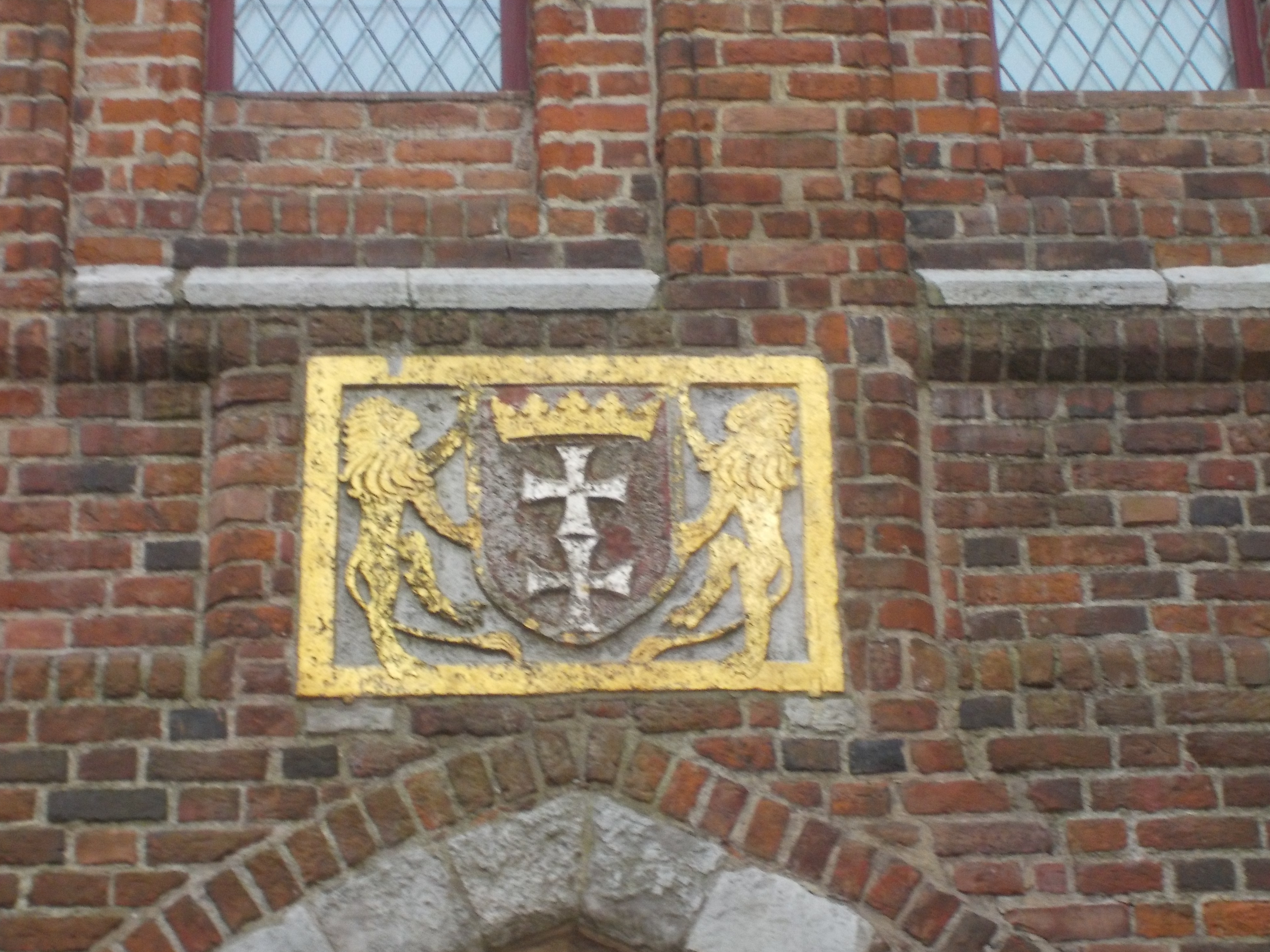


Above, what it looked like after German, and then Russian, occupation. You can see the rebuilt parts by the color of the brick.


June 2:
Many-hour bus ride from Gdańsk back to Warsaw, broken up by a “Be Our Guest” lunch (I think this is a Trafalgar Tours policy) at the Kwaśne Jabłko (that last word is so hard to pronounce, that even the Poles usually elide over it) farm and orchard. This is run by the cutest farming couple, deeply serious about the organic quality of their food, and sourcing locally. All of the food we were served was raised by farms within about a ten-mile radius, and they spoke eloquently (even in a second language) about the importance of multiple varieties of produce, keeping the land restored, and local eating. The unpronounceable name means “sour apples”, because they use the apples that grew “wild”, locally, to make hard cider. They say that while there are about sixteen varieties of apples sold worldwide in groceries, they have over forty on their farm, after decades of allowing apple trees to cross-pollinate. The owners were brilliant, and delightful.


